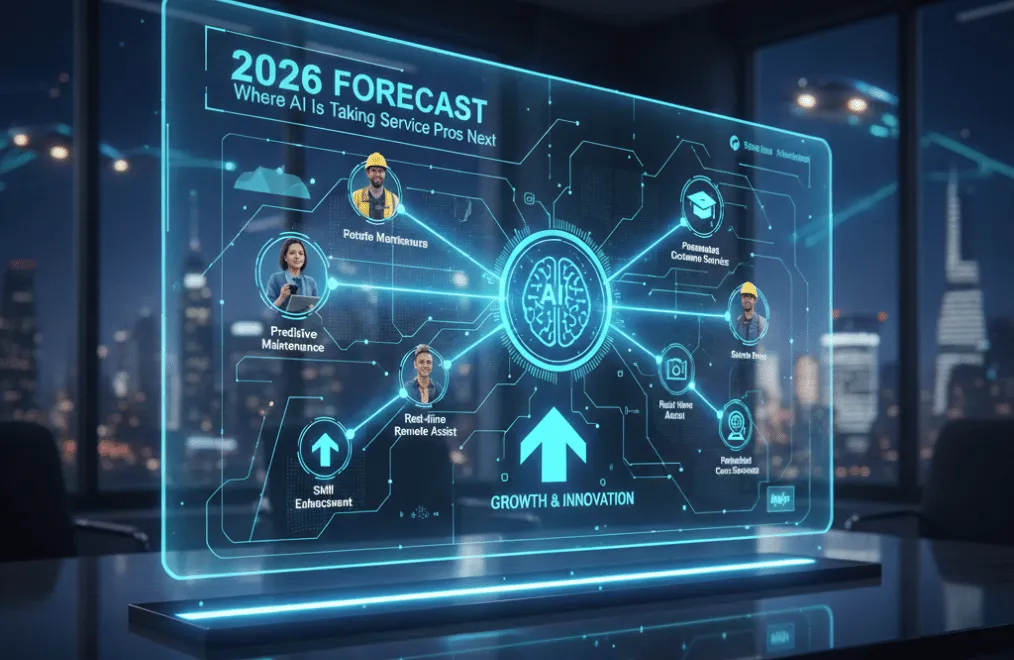
2026 Forecast: Where AI Is Taking Service Pros Next
2026 Forecast: Top AI Trends Transforming Home Service Pros with Automation, Voice AI, and GPT-Powered Follow-ups

2026 will be the year home service businesses shift from experimenting with AI to operationalizing it for reliable lead capture, faster booking, and measurable ROI. This forecast explains where automation, Voice AI, agentic systems, and GPT-powered follow-ups are headed, and it shows practical, CRM-centered steps service pros can take to turn those trends into revenue and efficiency. Readers will learn the top AI trends shaping the industry, how generative follow-ups change lead nurturing at scale, which CRM automation features move the needle, and how predictive models enable proactive maintenance. The article maps each trend to concrete CRM capabilities—call capture, scheduling, reporting—and provides a step-by-step adoption roadmap built for field teams and owners. Throughout, the emphasis is on tactics that generate leads, improve conversion, and save technician time while remaining mindful of data privacy and integration realities in 11/2025 market conditions.
What Are the Key AI Trends Shaping the Home Services Industry in 2026?
Agentic AI, Voice AI, GPT-powered follow-ups, predictive analytics, and integrated CRM automation are the top trends driving change in home services by 2026 because each enables distinct operational and commercial gains. Agentic AI creates autonomous task agents that handle scheduling and decision rules; Voice AI captures and routes calls 24/7; GPT systems automate personalized follow-ups; predictive models anticipate failures and optimize dispatch; and CRMautomation ties these capabilities together for measured ROI. Together these trends translate into higher answered-call rates, faster booking, fewer emergency visits, and clearer analytics for marketing spend. Service pros who map these trends to specific KPI goals—lead conversion, time saved, CSAT—can prioritize pilots that deliver quick wins and scale reliably.
Top trends to watch and why they matter:
Voice AI agents that capture intent and book jobs reduce missed calls and improve booking velocity.
Agentic AI that executes routine tasks (scheduling, quoting) cuts manual load and speeds response times.
GPT-powered follow-ups personalize outreach across SMS, email, and voicemail at scale to lift conversions.
Predictive analytics forecast failures and optimize maintenance scheduling to prevent downtime.
These trends intersect with related technologies such as field service management platforms, smart home sensors, and AI-as-a-Service providers, and they create new vendor-selection criteria centered on integration, privacy, and measurable KPIs.
How Is Agentic AI Driving Autonomous Operations for ServiceBusinesses?
Agentic AI refers to task-specific autonomous softwareagents that act on rules and live data to complete work without constant human direction, improving speed and consistency across operations. For servicebusinesses, agenticagents can autonomously assign appointments, adjust dispatch rules when technicians run late, and trigger follow-ups when estimates go unaccepted, which reduces friction and shortens the sales cycle. A concrete scenario: an agent detects a canceled slot, identifies a nearby high-priority lead, and books a technician within minutes—eliminating wasted travel time and increasing jobs per day. Organizations must manage risk by setting escalation rules and audit trails so agents operate within defined boundaries and preserve human oversight.
Agentic AI works best when integrated with CRM modules that expose scheduling, technician skill sets, and customer history; this semantic linkage ensures agents make context-aware choices, and it creates a transparent audit trail for compliance and continuous improvement.
What Role Does Voice AI Play in Revolutionizing Customer Interactions?

Voice AI transforms phone calls into CRM events by using conversational intent detection to capture leads, pre-qualify jobs, and schedule appointments around the clock, which increases reachable capacity and reduces missed opportunities. A typical workflow involves a customer call answered by a voice agent that confirms details, offers next-available windows, and generates a CRM booking with job notes—allowing technicians to arrive prepared and reducing back-and-forth. Voice AI also supports conversational routing to specialists and can hand off to human agents when complex issues arise, preserving service quality. Integration with call tracking and reporting ensures every captured interaction yields data that improves marketing attribution and conversion analysis.
Voice AI adoption requires attention to accuracy benchmarks and data privacy; service pros should pilot voice agents on non-critical flows, measure answer and booking rates, and iterate on intent models to ensure measurable uplift.
PulseCRM.ai illustrative vendor note
PulseCRM.ai offers an AI-powered CRM built for home-service businesses that illustrates these trends in practice. Its Voice AI and automation modules are positioned to automate calls, booking jobs, and follow-ups 24/7 while linking outcomes into reporting dashboards for ROI tracking. Reported platform metrics—such as a high call answer rate and measurable lift in lead conversion—make it a practical example of how voice and agentic automation combine to close more leads and save technician time.
How Will GPT-Powered Follow-ups Enhance Lead Nurturing and Customer Engagement?

GPT-powered follow-ups use generative models to create personalized, context-aware messages across email, SMS, and voicemail that maintain human tone while scaling outreach, improving response rates and conversion velocity. These systems ingest job details, past interactions, and customer preferences to craft timely messages that feel individualized, increasing the likelihood of booking and reducing manual outreach time. The mechanism works by combining templates, customer data, and generative prompts to produce variants that can be A/B tested and optimized automatically for best-performing subject lines, send times, and CTAs. For service pros, this means fewer cold leads slipping through the funnel and more opportunities converting without hiring additional staff.
Benefits and downstream effects include faster booking cycles, higher lead-to-booking conversion, and reclaimed administrative hours for technicians and dispatch teams.
List: Key GPT follow-up benefits
Personalized messages at scale that reflect job context and customer tone.
Faster response and booking times driven by optimal timing and channel choice.
Reduced manual work for staff through automated multi-step nurture sequences.
These benefits also raise data-handling considerations—consent, message logging, and opt-out handling must be embedded into any GPT-driven workflow to remain compliant and maintain customer trust.
What Are the Benefits of Personalized GPT Automation for Service Pros?
Personalized GPT automation increases relevance by using known customer data—previous services, property notes, and technician preferences—to tailor messages that address specific needs, which drives higher engagement. This personalization improves timing and tone, enabling message cadences that match customer responsiveness and reduce message fatigue. It scales without additional headcount, because the engine drafts and sequences follow-ups while staff review exceptions; as a result, teams reclaim hours that are better spent onsite or on complex customer interactions. Privacy considerations require that generative systems only use permitted customer data, maintain logs for consent, and provide transparent opt-out mechanisms to preserve compliance.
Implementing personalization should start with narrow templates and measurable KPIs—response rate, booking rate, and time saved—so teams can iterate and expand successful flows.
How Does AI-Driven CustomerCommunication Improve Sales Conversion?
AI-driven communication improves conversion by aligning message content and timing to customer signals, reducing friction in the booking path and accelerating decisions; this creates measurable lifts in lead-to-booking rates and shorter sales cycles. For example, an automated follow-up that references a detected service urgency and offers a same-day slot with a clear CTA increases the probability of immediate booking compared to generic outreach. Service pros should design experiments that compare AI-crafted variants against human-crafted messages, tracking conversion lift and time-to-book metrics to quantify value. Optimization requires continuous feedback loops where conversion data refines prompt templates, subject lines, and preferred channels.
A disciplined A/B testing plan combined with robust tracking provides the evidence needed to scale GPT-driven messaging across the customer lifecycle.
PulseCRM.ai product-focused integration (lead generation intent)
PulseCRM.ai’s GPT-enabled follow-up workflows are designed to supportlead generation, customer engagement, and conversion to sales by automating personalized sequences that re-engage leads and convert inquiries into booked jobs. Service pros evaluating GPT pilots should measure response lift, conversion rates, and hours saved to validate ROI and refine cadence.
What Are the Latest CRMAutomationTrends for Home ServiceProfessionals?
CRM systems are evolving from static contact lists to dynamic automation platforms that run booking flows, dispatch rules, follow-ups, and ROI reporting—turning CRM into an operational hub for field teams. Key advancements include smart scheduling that factors technician skills and travel time, an automated follow-up engine that sequences GPT messages, deep voice-call capture that converts conversations into actionable leads, and reporting dashboards that align marketing spend to booked revenue. These features reduce manual coordination, improve utilization, and provide visibility into the entire customer lifecycle so owners can allocate resources more profitably. Integration with field apps and third-party sensors (smart home tech) further enriches CRM data to enable predictive and proactive services.
Top CRM automation features and their typical impact:
Smart scheduling and dispatching for optimized routes and higher utilization.
Voicecall capture and routing to increase answered calls and bookings.
Automated follow-up engines for consistent lead nurturing and conversion.
These features intersect with sibling systems like field service management and AI-as-a-Service providers, and they require APIs and data governance to operate effectively.
Intro to CRM feature comparison table
How Does AI-Powered CRM Optimize Scheduling and Resource Management?
AI-powered scheduling optimizes technician assignments by matching skills, availability, and geography while minimizing drive time, which increases daily jobs completed and reduces fuel and idle time. These systems use historical job durations, travel-time models, and service priorities to sequence appointments and adjust in real time when delays occur. The immediate benefit is higher technician utilization and fewer missed windows, which improves customer satisfaction and reduces overtime costs. Implementation requires reliable field data—accurate job times, technician skills, and real-time location—and an integration layer between CRM, mobile apps, and dispatch tools.
A short implementation checklist helps teams scope pilots: define scheduling KPIs, select a route-optimization threshold, and instrument measurements for travel time and jobs-per-day.
How Can Data-Driven Decision Making Improve ServiceBusiness Outcomes?
Data-driven decisions come from dashboards that surface predictive KPIs—lead-to-booking ratios, response times, technician utilization, and lifetime value—so owners can align staffing and marketing budgets to measurable outcomes. Predictive insights guide pricing, promotional targeting, and capacity planning by forecasting demand windows and likely no-shows. Short experiments, such as A/B testing new messaging or pricing offers, validate hypotheses against these KPIs and create a culture of iterative improvement. For success, teams must establish reporting cadence, own key metrics, and ensure data quality, otherwise recommendations will mislead rather than inform.
A disciplined reporting cadence paired with predictive signals lets companies scale successful processes and stop low-performing experiments quickly.
How Is Predictive AI Enabling Proactive Maintenance and Smarter Service Delivery?
Predictive AI applies models trained on historical service data, equipment usage, and sensor inputs to forecast failures and recommend pre-emptive maintenance, which reduces emergency calls and extends asset life. In home services, predictive models can flag HVAC components likely to fail before peak seasons, trigger preventive visits, and prioritize parts inventory—lowering downtime and enhancing customer trust. The mechanism combines time-series analysis, anomaly detection, and rule-based orchestration to convert signals into scheduled inspections. Integrating predictive outputs into CRM and dispatch systems ensures recommended visits become booked appointments rather than ignored alerts.
Predictive workflows require reliable inputs—service records, sensor telemetry, and usage patterns—and careful validation to avoid false positives that erode trust.
Intro to predictive model comparison table
What Are the Advantages of Smart Scheduling and Resource Optimization?
Smart scheduling improves technician utilization, reduces travel time, and increases daily completed jobs by using routing algorithms and skill matching to place the right technician at the right time. Operational gains include fewer late arrivals, higher first-time fix rates due to better skill matching, and reduced overtime because the system balances workloads efficiently. Realizing these gains requires accurate baseline metrics and feedback loops: measure drive-time reduction, jobs-per-day changes, and first-time fix improvements to validate impact. Teams should phase deployment, starting with high-density zones or specific service types to limit complexity while proving ROI.
These operational improvements directly affect customer satisfaction and revenue per route, making scheduling optimization a high-priority investment.
How Does Predictive AI Reduce Downtime and Enhance Customer Satisfaction?
Predictive AI reduces downtime by surfacing early indicators of equipment stress, prompting pre-emptive inspections that prevent emergency failures and shorten repair times when problems do occur. From a customer perspective, fewer unexpected servicecalls and proactive scheduling increase perceived reliability and trust, which boosts CSAT and referral rates. Measurement involves tracking the reduction in emergency call volume, changes in average repair time, and customer satisfaction scores tied to predictive-driven visits. Organizations should design experiments that link alerts to booked preventive visits and measure downstream revenue protected by avoided breakdowns.
Demonstrable reductions in emergency work and improvements in CSAT are the primary proof points for scaling predictive initiatives.
What Practical Steps Can Service Pros Take to Prepare for AI Adoption in 2026?
Service pros should follow a phased adoption roadmap: assess data readiness, pilot high-impact automations (voice capture, GPT follow-ups, smart scheduling), train staff, and scale with governance and measurement. Start by auditing data sources—CRM records, field app logs, and sensor feeds—to ensure quality and API access for integrations. Pilots should be narrow, aim for measurable KPIs (answer rate, conversion uplift, hours saved), and include rollback plans. Training and change management must prepare technicians and office staff for new workflows, define champions, and collect adoption metrics to refine rollouts.
List: Four-step phased adoption roadmap
Assess readiness: inventory data, systems, and staff capacity for pilots.
Pilot targeted features: pick one voice or follow-up flow and measure KPIs.
Train and iterate: run short training cycles and gather feedback from frontline teams.
Scale with governance: implement privacy and escalation rules and measure ROI.
This structured approach reduces risk, accelerates learning, and ensures early wins are defensible with data.
How Do You Assess AI Readiness and Plan Phased Deployment?
Assess readiness by asking specific questions about data completeness, API availability, and staff bandwidth: is contact and job history clean? Can your field app expose location and duration data? Are stakeholders available for testing? Use those answers to define a pilot scope with clear KPIs—e.g., improve answered-call rate by X% or reduce manual follow-up hours by Y per week—and set 30/60/90 day milestones. Pilots that include monitoring dashboards and rapid feedback loops let teams iterate quickly and avoid lengthy development cycles. A small, measurable pilot reduces deployment risk and creates a template for broader rollout.
Documenting pilot scope, success criteria, and rollback thresholds is essential for governance and stakeholder alignment.
What Training and Change Management Are Needed for Successful AI Integration?
Training should cover tool usage, new messaging standards, privacy practices, and escalation protocols so field staff and office teams adopt automation with confidence. Create short modules for dispatchers, technicians, and customer-service staff that combine hands-on practice with real examples and measure adoption via usage metrics and time-saved calculations. Change management requires visible champions, regular communication of pilot results, and mechanisms for frontline teams to suggest refinements. Adoption metrics—login frequency, automated booking acceptance, and reduction in manual tasks—help quantify success and guide additional training or process adjustments.
Sustained adoption depends on demonstrating tangible time savings and conversion improvements to build trust in AI-driven workflows.
PulseCRM.ai recommended pilot and training note
For teams seeking a vendor-ready option to pilot voice capture and GPT follow-ups, PulseCRM.ai can be considered as a vendor for early deployments. Its platform bundles Voice AI, automation for follow-ups, robust reporting for ROI tracking, and an Ad Manager to tie leads back to marketing spend. Service pros should evaluate PulseCRM.ai by piloting voice capture and follow-up sequences, measuring improvements in call answer rates and conversion, and tracking hours saved per week as core success metrics.
How Can Pulscrm.ai's AI Solutions Empower Home ServiceBusinesses in 2026?
PulseCRM.ai maps directly to the forecasted trends by offering Voice AI for lead capture, an automated follow-up engine that supports GPT-style messaging, scheduling and dispatch modules, and reporting dashboards to measure conversion and time savings. These product alignments turn conceptual AI benefits into operational capabilities: voice capture increases answer rates, follow-up automations re-engage leads, and reporting ties results back to marketing spend and technician efficiency. The allowed business metrics indicate practical outcomes service pros should test—higher answer rates, improved conversion, and hours reclaimed through automation. Evaluating a vendor like this requires measuring the specific KPIs spelled out in pilot plans and validating integration with field apps and financial systems.
Mapping features to measurable outcomes helps teams prioritize which modules to adopt first and how to structure ROI measurement.
How Does Pulsecrm.ai's Voice AI Improve Lead Capture and Customer Service?
PulseCRM.ai’s Voice AI is designed to answer calls and convert those interactions into CRM records that include job details, contactdata, and suggested booking windows—turning missed calls into measurable opportunities. By automating initial qualification and offering booking options, the system aims to increase answered-call rates and reduce the manual intake burden on staff, enabling faster technician dispatch and better-prepared visits. Tracking these interactions in a reporting dashboard provides visibility into marketing attribution and conversion funnels, allowing owners to optimize spend and staffing. Service pros piloting voice capture should measure call answer rate, booking rate from captured calls, and change in time administrative staff spend on intake.
Suggested pilot metrics include answered-call percentage, lead-to-booking conversion, and administrative hours reclaimed to validate impact.
In What Ways Do GPT-Powered Follow-ups Save Time and Boost Conversions?
PulseCRM.ai’s follow-up automations leverage generative messaging templates and rules to send personalized, multi-channel sequences that re-engage leads and reduce manual outreach, which translates into measurable time savings and conversion improvements. Automating nurture sequences can save teams over ten hours per week in manual follow-ups, while optimized messaging and timing aim to convert more leads—metrics that should be tracked during pilots. A recommended A/B test compares automated GPT-crafted sequences against standard manual messages to quantify conversion uplift and confirm the lead conversion improvement claims in controlled contexts. Validating time saved, conversion uplift, and customer response rates gives owners the data required to scale automation responsibly.
For teams ready to evaluate vendor solutions, focus pilots on measurable outcomes—response rates, bookings, and hours saved—to determine whether to expand automation across the business.


