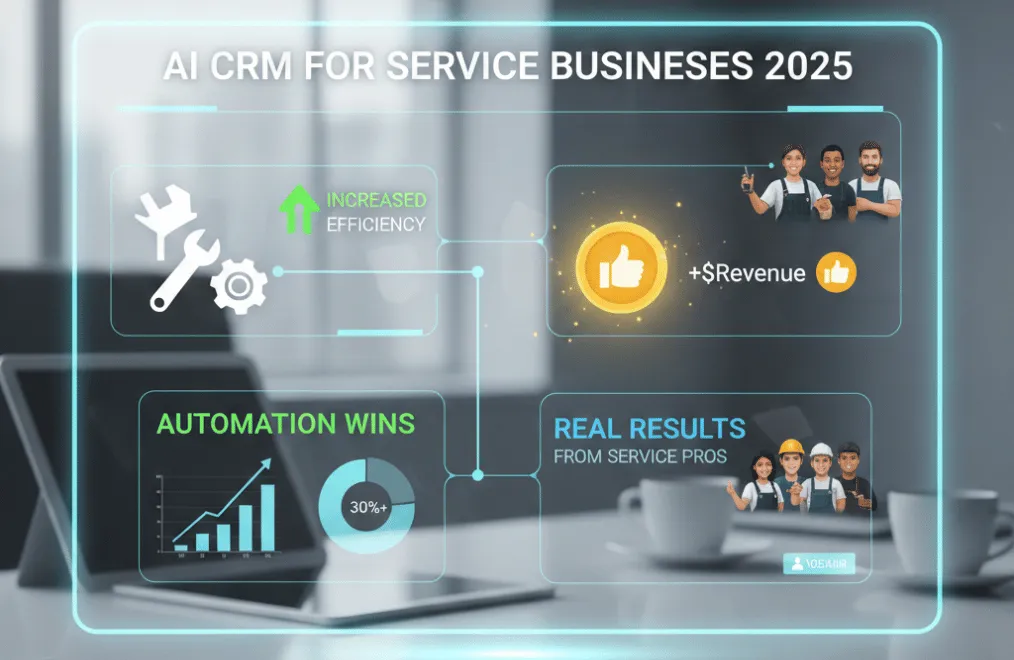
Automation Wins of 2025: Real Results from Service Pros
AI CRM for Service Businesses 2025: Automation Wins and Real Results from Service Pros with Pulsecrm.ai

Automation didn’t just “help” in 2025 — it changed the game for service businesses that needed speed, reliability, and measurable ROI from customer interactions. This article lays out how AI-powered CRMs reshaped response times, booking rates, and after-hours revenue protection across trades like HVAC, plumbing, and contracting, using practical examples and quantifiable impacts. Readers will learn the core mechanisms—Voice AI reception, automated follow-up sequences, and unified reporting—that produce consistent outcomes, plus step-by-step workflows and metrics to replicate those wins. We map specific features to business outcomes, present scannable case snapshots with numeric results, and show how to measure ROI so owners can make data-driven decisions. The following sections cover how automation transformed service businesses in 2025, which real pros saw measurable results, how after-hours revenue was protected, feature-to-benefit mappings, future trends, and precise steps for getting started with PulseCRM.ai.
How Did AI-Powered Automation Transform Service Businesses in 2025?
AI-powered automation transformed service businesses in 2025 by reducing response times, increasing booked jobs, and protecting revenue outside normal hours through continuous, rules-driven workflows. The mechanism combined a Voice AI receptionist to capture and qualify calls, automated follow-up sequences that re-engaged leads, and a reporting layer that tied campaigns to bookings for instant ROI visibility. Faster answers and instant qualification compressed the lead-to-booking window, converting more inquiries into scheduled jobs and turning missed opportunities into measurable revenue. These shifts mattered especially for businesses facing seasonal spikes and emergency calls, because automation scaled reliably when human teams were stretched.
Service pros realized three repeatable outcomes that defined the year: quicker contact-to-booking cycles, measurable lift in conversions, and reduced operational overhead. Each outcome stemmed from linked components—call answering, scheduling engine, and lead scoring—that worked together rather than as disconnected tools. Understanding these components clarifies why many operators replaced patchwork stacks with unified AI-driven systems that deliver predictable results. The next subsection details the primary benefits home-service businesses gained from this new automation model.
What Are the Key Benefits of AI CRM for Home Services?

AI CRM for home services delivers faster lead capture, higher booking rates, and consistent customer engagement by automating the tasks that most often cause leakage in the sales funnel. By answering calls instantly and qualifying intent, a Voice AI receptionist shortens time-to-response and raises the effective answer rate, which directly increases the pool of bookable leads. Automated follow-up sequences—SMS, email, and scheduled outbound calls—re-engage prospects who might otherwise drop out, improving conversion rates while freeing staff for onsite work. These benefits compound: fewer missed calls, faster confirmations, and automated reminders reduce no-shows and increase same-day or next-day bookings.
In practice, the workflow starts with an AI capture, continues with qualification and immediate booking or nurturing, and closes with attribution in a single reporting view. This integrated path explains why businesses see steady improvements in lead-to-booking metrics rather than one-off spikes. The next subsection breaks down how a platform like PulseCRM.ai operationalizes faster responses and higher bookings through concrete mechanisms.
How Does Pulsecrm.ai Enable Faster Responses and More Bookings?
PulseCRM.ai speeds responses and increases bookings by combining a Voice AI answering module with automation rules that triage, schedule, and confirm jobs without manual handoffs. The Voice AI receptionist captures caller intent using natural language processing, applies triage rules to score urgency, and triggers the scheduling engine to offer available slots or route high-value jobs to on-call staff. Confirmations, reminders, and follow-ups run automatically across SMS and email channels, which reduces friction for customers and improves show rates. Integrated reporting ensures high-value ad campaigns are routed quickly, enabling teams to act on hot leads faster and with better conversion outcomes.
These mechanisms remove common bottlenecks—missed calls, slow callbacks, and fragmented lead data—so businesses see measurable gains in booked jobs and revenue per lead. With clearer attribution and automated routing, operators can prioritize technician dispatch and marketing spend toward channels that deliver the highest return. The following presents concise case snapshots showing these dynamics in real service businesses.
Which Real Service Pros Achieved Measurable Results Using Pulsecrm.ai?
PulseCRM.ai customers across contracting, HVAC, and plumbing reported measurable outcomes that map directly to specific automation features and workflows. Lead generation, customer engagement, and conversion to sales. The EAV-style snapshots below present challenge → solution → numeric result so readers can scan quickly and understand which mechanisms produced each outcome. These examples illustrate how Voice AI, automated follow-ups, and unified reporting combined to turn inquiries into booked jobs and attributable revenue.
The cases show consistent patterns: faster answer rates, increased booked jobs, and time saved from tool consolidation, which together delivered clear ROI within weeks of activation. The table that follows highlights representative customer problems, the targeted PulseCRM.ai feature used, and the measurable result each client reported.
These snapshots demonstrate how aligning a specific feature to a business problem produces measurable improvements quickly. Each example ties the outcome to a PulseCRM.ai component—Voice AI, Automations, or Reporting—so other pros can replicate the same configuration. The next section focuses on contractor-specific follow-up wins and how those sequences produced measurable increases.
What Are the Top Contractor AI Follow-Up System Success Stories?
Contractors using automated follow-up sequences saw significant re-engagement and conversion lifts by combining timed SMS, templated emails, and priority callbacks based on lead score. Typical cadences triggered an immediate confirmation, a 24-hour reminder, and a multi-day nurture sequence that revived cold leads and converted estimates into scheduled jobs. These follow-ups replaced ad-hoc outreach with consistent, measurable actions, yielding reported conversion increases and freeing office staff for higher-level tasks. Integration with the scheduling engine ensured that when a lead responded, the system could instantly present available appointments, making conversion immediate and seamless.
The result was a clear improvement in both conversion rates and labor allocation: administrative hours dropped while booked jobs rose—a practical efficiency gain for small teams. The following subsection highlights HVAC and plumbing vertical examples where automation handled emergencies and seasonal demand.
How Did HVAC and Plumbing Businesses Boost Bookings with AI Automation?
HVAC and plumbing businesses used AI automation to capture emergency calls, qualify urgency, and offer same-day or next-day appointments automatically, which increased booked jobs during peak windows. Voice AI captured caller details and applied urgency rules that prioritized dispatch for high-risk calls, while automations filled scheduling gaps and sent confirmations to reduce no-shows. During seasonal spikes, automated triage and load-leveling rules distributed work evenly across crews and offered alternative time slots to customers, improving customer satisfaction and operational throughput. Reporting dashboards then linked bookings back to acquisition channels so teams could scale what worked.
These vertical-specific workflows turned unpredictable demand into manageable capacity, directly increasing revenue and customer retention through faster, more reliable service. The next examines how after-hours availability protected revenue when human teams were offline.
How Does Pulsecrm.ai Protect After-Hours Revenue with 24/7 AI Availability?
24/7 AI availability protects after-hours revenue by capturing inbound contacts whenever they occur, qualifying intent immediately, and either booking jobs or initiating high-value follow-ups that convert once staff resume work. Voice AI acts as a continuous receptionist, reducing missed opportunities that traditionally occurred overnight or during weekends. Automated follow-ups convert many after-hours captures into scheduled jobs with measurable uplift because the lead was engaged quickly and consistently. The EAV table and workflow below show typical after-hours flows, the actions taken, and their conversion impact to make the mechanics and outcomes transparent.
Because revenue loss often happens when leads go unanswered, an always-on AI layer closes that gap and converts previously missed calls into tangible bookings and attributed revenue. The next subsection examines the specific role Voice AI plays in capturing and qualifying these out-of-hours leads.
This table highlights how structured after-hours flows convert captured interactions into bookings and revenue rather than lost opportunities. The next details Voice AI capabilities in practical terms.
What Role Does Voice AI Play in Capturing Leads After Hours?

Voice AI serves as a natural-language receptionist that captures caller intent, extracts key details, and either books appointments directly or generates prioritized follow-up tasks for staff. It uses conversational qualification to assess urgency, checks available time slots through the scheduling engine, and can provide immediate confirmation messages that reduce friction for customers. Voice transcripts feed into reporting and follow-up automations, creating a data-rich loop that improves future routing and scoring. For urgent jobs, Voice AI can initiate a priority alert so on-call personnel act quickly the next morning, preserving the chance to convert high-value leads.
By replacing missed calls with qualified, actionable records, Voice AI increases effective answer rates and raises downstream booking potential. The following subsection explains how automated follow-ups convert after-hours captures into jobs through consistent, multi-channel cadences.
How Do Automated Follow-Ups Increase Job Conversion Rates?
Automated follow-ups use a multi-channel cadence—immediate SMS confirmation, a 24-hour reminder, and a short nurture series—to keep leads engaged until a human can finalize scheduling, which materially increases conversion probabilities. Typical sequences combine concise booking prompts, easy-response options, and technician availability windows so customers can accept appointments with minimal friction. Measurable conversion lifts result because timely, relevant reminders reduce decision inertia and emphasize available slots before competitors reach the prospect. Automation also reallocates staff time by handling routine outreach automatically, allowing teams to focus on onsite work and complex cases.
Tracking open rates, click-to-book rates, and follow-up-driven bookings in the reporting panel makes the impact visible and reproducible for optimization. The next maps core features to business benefits and compares integrated platforms to disconnected stacks.
What Are the Automation Benefits for Home Services Using Pulsecrm.ai?
Lead generation, customer engagement, and conversion to sales. Home-service businesses benefit from automation through consolidated tooling, time savings, and measurable attribution that turns marketing and operations into coordinated revenue engines. Replacing a disconnected tool stack reduces integration overhead, eliminates data silos, and shortens time-to-action for incoming leads. Reporting ties campaign spend to booked jobs so teams can reallocate budget to high-performing channels and measure true revenue uplift rather than vanity metrics.
The integrated platform approach yields operational simplicity and predictable outputs: fewer systems to maintain, consistent customer experiences from call to completion, and immediate visibility into conversion funnels. The next subsection enumerates which common tools are typically replaced and the net operational benefit of consolidation.
How Does Pulsecrm.ai Replace Disconnected Tools to Streamline Operations?
PulseCRM.ai replaces several common categories of tools—answering services, separate booking apps, email automation platforms, basic reporting tools, and ad management dashboards—by consolidating those capabilities into one system. This reduces the number of vendor integrations, lowers administrative complexity, and shortens onboarding time for staff because workflows are standardized. Consolidation also reduces the risk of data loss between systems and improves the accuracy of attribution when reporting links ad campaigns to bookings directly. Operationally, that means less time reconciling leads and more time delivering service.
The net benefits include faster decision cycles, lower monthly tooling overhead, and clearer insight into which marketing actions drive revenue. The following subsection explains how ROI is measured and tracked inside the platform’s reporting features.
How Is ROI Measured and Tracked with Pulsecrm.ai Reporting Features?
ROI measurement centers on tracking answer rate, lead conversion rate, booked jobs, and revenue per lead, then attributing those bookings back to campaigns to show clear returns on marketing investment. Dashboards display these KPIs alongside trend lines and segmented views by channel, technician, or service type, making it straightforward to identify high-performing strategies. Exportable reports and visualizations support weekly reviews and help prioritize optimization efforts that increase bookings and reduce cost per lead. This attribution foundation is essential for scaling promotions and justifying automation investments.
An example EAV-style table below clarifies key KPIs, their definitions, and the business insight each provides.
These metrics enable service pros to quantify automation wins and iterate on processes to increase predictable revenue. The next looks ahead to emerging trends that will shape CRM-driven automation beyond 2025.
What Future Trends in AI CRM Will Shape ServiceBusinessAutomation Beyond 2025?
Predictive analytics, tighter field-data integration, and deeper personalization will drive the next wave of CRM value for service businesses after 2025. Predictive models will forecast demand, prioritize leads based on conversion propensity, and surface maintenance opportunities from aggregated job histories. Integrating field telematics and IoT signals into CRM workflows will enable proactive scheduling and predictive maintenance offers, increasing recurring revenue and customer lifetime value. As automation matures, personalization at scale—tailoring outreach timing and messaging to individual behaviors—will become a standard expectation rather than a premium feature.
Companies that adopt predictive and connected approaches will gain competitive advantage through improved resource allocation and higher booking efficiency. The following list suggests practical actions leaders can take now to prepare for these trends and avoid falling behind.
Invest in data hygiene and unified customer records to enable accurate predictive scoring.
Pilot predictive lead-priority models on a subset of campaigns to validate uplift before scaling.
Integrate field data sources gradually, starting with the highest-value signals like completed-job outcomes.
Preparing in these ways positions businesses to extract maximum value from AI-driven personalization and predictive scheduling. The next subsection explains how predictive analytics enhances engagement and conversion in practical terms.
How Is Predictive Analytics Enhancing Customer Engagement and Sales Conversion?
Predictive analytics enhances engagement by scoring leads on conversion probability using behavioral signals, job history, and seasonality, allowing teams to prioritize outreach and allocate resources more efficiently. These models surface high-impact opportunities—such as customers likely to accept maintenance plans or emergency service—so automated workflows can present timely offers that convert at higher rates. Personalization engines then adapt messaging to the customer’s context, increasing relevance and response. The result is a higher conversion rate per outreach attempt and improved marketing ROI because spend is focused on the most likely-to-convert segments.
As models learn from ongoing outcomes, the system becomes increasingly effective at routing and messaging, creating a virtuous cycle of improved engagement and conversion. The following subsection makes the strategic case for digital transformation in this era.
Why Is Digital Transformation Critical for Service Pros in 2025 and Beyond?
Digital transformation is critical because it delivers scalability, resilience, and predictable growth that manual processes cannot match in increasingly competitive markets. Businesses that digitize lead capture, scheduling, and follow-up reduce missed opportunities and create standardized customer experiences that scale across crews and locations. Transformation also insulates operations against staffing variability by embedding reliable automation into core workflows. The practical checklist below outlines first steps leaders can take to begin modernization.
Audit: Map current lead flows and identify leakage points.
Prioritize: Choose automation targets with clear ROI (answering, booking, follow-ups).
Pilot: Run a short pilot to validate metrics before full rollout.
These steps keep transformation pragmatic and measurable, ensuring incremental wins build toward sustainable growth. The final details how service pros can get started with PulseCRM.ai to maximize those automation wins.
How Can Service Pros Get Started with Pulsecrm.ai to Maximize Automation Wins?
Lead generation, customer engagement, and conversion to sales. Getting started begins with a focused audit, followed by a staged migration, configuration of core automations, staff training, and continuous optimization to capture early ROI. PulseCRM.ai offers concierge migrations and templates tailored to home-service verticals to accelerate time to first booking automation, minimizing disruption while delivering measurable outcomes. Beginning with high-impact automations—Voice AI answering, immediate booking flows, and a baseline follow-up cadence—typically generates quick wins that fund broader rollout.
A practical three-step plan helps teams move from evaluation to measurable results with minimal friction and clear KPI tracking. The next outlines available support and implementation services to shorten time to value.
What Support and Implementation Services Does Pulsecrm.ai Offer?
PulseCRM.ai provides concierge migration services, 24/7 support, and industry-specific training resources designed to accelerate onboarding and ensure best-practice automations are implemented correctly. Concierge migrations move historical lead and customer data into a unified CRM, while configuration assistance sets up Voice AI prompts, scheduling rules, and follow-up cadences tuned for specific trades. Ongoing 24/7 support helps troubleshoot live issues and refine automations as business patterns emerge. Typical timelines to first booking automation are short when migrations and templates are used, enabling teams to see the benefits within weeks rather than months.
This support structure reduces implementation risk and helps smaller teams achieve the operational consistency needed to scale automation wins. The final subsection points service pros to the types of resources available for deeper learning.
Where Can Service Pros Find Industry-Specific Automation Resources and Case Studies?
PulseCRM.ai maintains a library of vertical case studies, follow-up sequence templates, call scripts, video demos, and infographic resources that service pros can use to adopt proven automations quickly. These resources include examples tailored to HVAC, plumbing, and contracting workflows that illustrate exact automations and expected metric improvements. Template sequences and scripts reduce trial-and-error by providing tested starting points that teams can modify for local conditions. Video demos show real flows end-to-end, and case studies reveal the measured before/after impacts for easier internal buy-in.
Using these resources shortens the learning curve and increases the likelihood of early, repeatable wins from automation.
AI-Enhanced Customer Relationship Management Systems: Transforming Customer Engagement and Business Expansion The integration of artificial intelligence (AI) has fundamentally reshaped the domain of customer relationship management (CRM), empowering organizations to leverage intelligent automation, predictive analytics, and data-driven intelligence. This paper examines the transformative influence of AI-powered CRMs on organizational performance, emphasizing their capacity to deepen customer comprehension, individualize interactions, and optimize operational workflows. By employing AI algorithms to process extensive customer datasets, these sophisticated CRM frameworks enable businesses to forecast customer requirements, discern emergent market dynamics, and facilitate evidence-based strategic planning. The article scrutinizes the principal benefits of AI-driven CRMs, encompassing elevated customer satisfaction, augmented productivity, and improved profitability. Furthermore, it addresses the implementation hurdles of AI within CRM, such as data privacy considerations and workforce assimilation, while offering actionable recommendations.
The evolution of AI in CRM systems highlights a significant shift towards intelligent automation and data-driven insights, fundamentally altering how businesses engage with their customers and expand their operations.
Enhancing Product Sales Offer Follow-Up Through Automation The analysis then scrutinizes specific service flow streams, highlighting that the offer follow-up process is critical for improving conversion rates, with automation and tracking systems significantly enhancing this follow-up.
The critical nature of offer follow-up in sales processes is underscored by research indicating that automation and robust tracking systems are key drivers for improving conversion rates.
Automated Customer Order Processing and Follow-Up: An ABB Case Study Ultimately, this research contributes to the domain of business process automation and offers insights into the transformative effects on automation-centric enterprises.
The impact of business process automation is profound, offering transformative effects for enterprises that prioritize automation-centric strategies, as demonstrated by case studies in order processing and follow-up.


