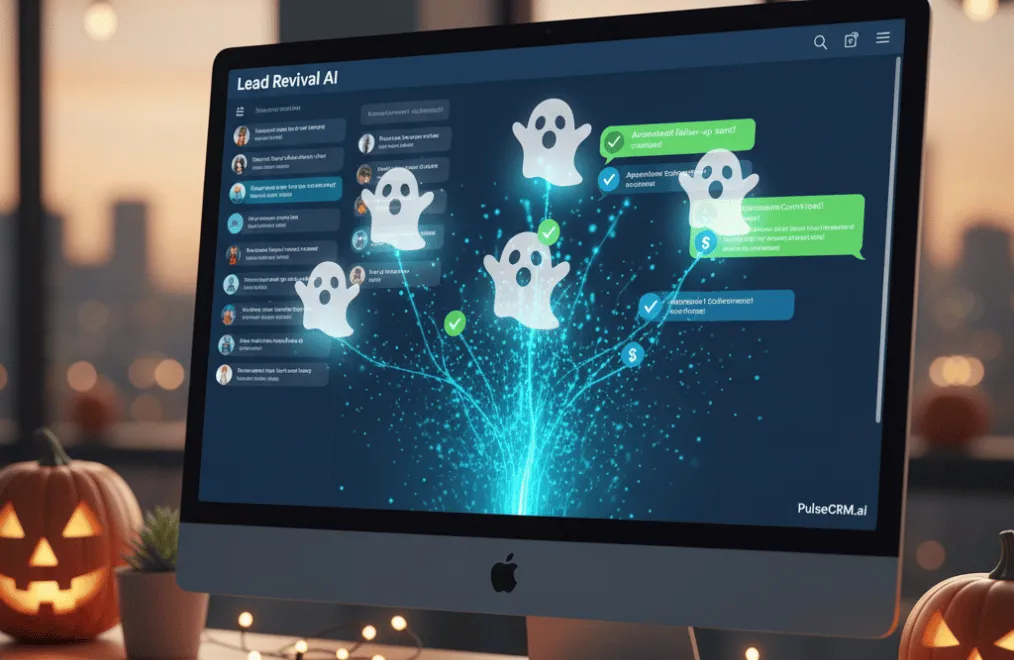
Don’t Get Ghosted: Recover Dead Leads Before Year’s End.
Revive your sales with powerful marketing automation tools. Enhance lead recovery and streamline processes with AI-driven CRM solutions designed for success.

Don’t let silent prospects determine your Q4 revenue: ghosted leads are contacts who stopped responding, and they can quietly drain year-end profits if left unattended. This guide explains what ghosted leads are, why they matter for service professionals, and how targeted AI marketing automation—using techniques like smart texts, AI-driven emails, and timely reminders—can reactivate dormant opportunities before December. You will learn diagnostic steps to identify high-value dormant leads, multi-channel cadences that combine SMS and email, and measurement frameworks to quantify recovered revenue. The article maps the psychology of disengagement to practical messaging templates, offers workflow examples you can implement quickly, and shows how to prioritize campaigns with an ROI-first mindset. Throughout, we integrate service-pro examples and practical tables that compare workflows and calculate potential returns, and we highlight how lead reactivation flows convert silence into sales while preserving pipeline accuracy. By the end you’ll have a step-by-step playbook to revive cold prospects, testable templates to send today, and an approach to measure results that informs where to scale further.
What Are Ghosted Leads and Why Do They Threaten Year-End Profits?
Ghosted leads are prospects who previously engaged but stopped responding; this disengagement reduces pipeline velocity by removing near-term opportunities and inflating forecast risk. The mechanism behind the threat is simple: time-sensitive intent decays and competing priorities steal decision momentum, which lowers the probability of conversion as the calendar advances toward year-end. Recovering even a small percentage of these dormant contacts can return disproportionate revenue because Q4 decision windows, budget rollover, and annual planning create a higher effective conversion value. Service professionals face a double penalty: ghosted leads both consume CRM space and create false confidence in pipelines until contacts are marked lost. Addressing ghosted leads before December converts latent opportunities into bookings, stabilizes forecasts, and improves salesperson productivity by focusing manual effort on high-potential reactivations.
What Causes Leads to Go Cold or Become Ghosted?

Leads go cold for behavioral, operational, and contextual reasons that reduce response probability; common causes include timing mismatches, competing priorities, unclear value, and administrative friction. Decision makers often delay because budgets aren’t aligned, schedules are tight, or because a proposal lacks a clear next step, and these factors create natural windows where outreach needs to be re-timed. Operational problems such as mis-sequenced follow-ups or poor message relevance also erode trust and prompt silence, especially when messages feel generic or untimely. For service pros, typical micro-scenarios include a homeowner postponing non-urgent repairs until tax season or a business manager delaying a facility upgrade until year-end budgeting; recognizing these status cues helps craft targeted reactivation tactics. Understanding these causes directly informs cadence design, because the timing and channel must match the lead’s friction point to reawaken interest.
How Do Ghosted Leads Affect Service Professionals’ Sales Pipelines?
Ghosted leads create pipeline leakage that hides actual revenue potential and skews forecasting through inflated opportunity counts and low probability estimates. The mechanism is a slow bleed: leads labeled “active” but unresponsive continue to occupy pipeline stages, leading managers to overestimate stage conversion and under-invest in reactivation flows. For service pros who operate on schedule-driven revenue—appointments, installations, follow-ups—this effect amplifies labor misallocation and missed booking slots that could have been filled with reactivated contacts. The operational cost includes manual chasing, duplicate outreach, and wasted quoting effort, which reduces margin per booked job. To close this gap, teams must detect lead age and engagement signals and route cold contacts into automated reactivation sequences rather than continuing ad-hoc manual outreach.
Why Is Year-End the Critical Time to Recover Dormant Leads?

Year-end is critical because seasonal budget behavior, quota-driven urgency, and planning cycles converge to increase conversion value for reactivated leads, making reactivation a high-leverage activity. The reason is behavioral economics: many buyers reprioritize spending before fiscal year close or include deferred projects in next-year plans, so an outreach timed to those decision points often yields faster commitments. For service professionals, December and the surrounding months also present booking windows for maintenance contracts, prepping for seasonal demands, or capitalizing on year-end discounts, which create urgency triggers that reactivation campaigns can exploit. Tactical implication: prioritize leads with high average deal size and recent intent signals for Q4 campaigns, because converting those offers the highest ROI in a compressed timeline. Mapping lead segments to Q4 triggers maximizes the chance that dormant opportunities will convert into actual bookings before the year ends.
How Does PulseCRM.ai Use AI Marketing Automation to Reactivate Cold Leads?
Lead reactivation with AI marketing automation combines segmentation, predictive scoring, tailored messaging, and channel sequencing to surface dormant opportunities and re-engage them with the right message at the right moment. The mechanism begins with behavioral analysis—lead scoring and engagement decay detection—that classifies cold leads and selects an optimal reactivation path, then applies personalized templates across SMS and email channels while monitoring responses to adjust timing and content. The specific benefit for service pros is that automation preserves human time while delivering timely, personalized touches that restore momentum and increase conversion probability. Automated decision nodes route engaged contacts back to live sales, mark uninterested prospects for suppression, and escalate hot leads for immediate scheduling. This systematic approach reduces manual follow-up friction and increases recovered revenue by creating predictable reactivation outcomes from previously silent contacts.
What Are Lead Reactivation Flows and How Do They Work?
Lead reactivation flows are sequenced automation paths that move a cold lead through diagnosis, targeted outreach, and routing based on response behavior; they start with segmentation, trigger on inactivity or score decline, and progress through prioritized channels. The mechanism: a flow uses time-since-last-contact, behavior signals (e.g., quote opened), and lead value to select a channel sequence—often SMS first, then email, then a reminder call—each with tailored templates and decision nodes. The value of this mechanism is predictable re-qualification: contacts that respond are tagged and routed to booking, while non-responders receive breakup messages to preserve deliverability. A sample flow for a service pro might begin with an immediate smart text nudge, follow with an AI-personalized value email at 48 hours, then send scheduling reminders and a final breakup after two weeks, which reduces manual chasing while recovering leads efficiently.
How Do Smart Texts Engage Dormant Prospects Instantly?
Smart texts use SMS’s high open and response rates to deliver concise, personalized nudges that restart conversations quickly; the mechanism is immediacy combined with relevance, which prompts micro-commitments like “reply YES to schedule.” Because SMS bypasses crowded inboxes and shows near-immediate engagement, smart texts are effective triggers for reactivation when timed to behavioral cues such as missed appointments or quote opens. Best practices include using the lead’s name, referencing the last interaction, offering a low-friction CTA, and including scheduling options to reduce friction. Sample templates can be simple: a two-line text referencing recent interest plus a time option; this low-effort prompt frequently generates a quick “interested” or “call me” response that the automation flow converts into a booked slot. For compliance and deliverability, maintain opt-in records and pace texts to avoid oversaturation.
How Do AI-Driven Emails Nurture and Convert Cold Leads?
AI-driven emails increase relevance by optimizing subject lines, selecting dynamic content blocks, and adjusting send times based on individual engagement patterns, which improves open and click-through rates for reactivation sequences. The mechanism uses historical interaction data and model-driven personalization to present the most resonant value proposition—whether a case study, limited offer, or scheduling prompt—so the message feels tailored rather than generic. Sequence examples include a re-introduction note highlighting recent interest, a second email offering a time-limited discount or priority scheduling, and a case-study email demonstrating outcomes for similar service clients; each message uses AI to adapt subject lines and CTAs for better response. Measurement and micro A/B tests should focus on open-to-response conversion and time-to-booking to iterate content and timing across segments, which steadily increases recovered conversions.
What Role Do Timely Reminders Play in Follow-Up Success?
Timely reminders act as friction removers for both prospects and sales teams by prompting action at decision moments and reducing missed scheduling opportunities. The mechanism is simple: reminders—sent via SMS, email, or calendar nudges—reduce no-shows, confirm intent, and maintain top-of-mind status for prospects who are considering options but haven’t committed. Schedule logic should include appointment confirmations, pre-visit checklists, and post-quote nudges timed to maximize response without causing fatigue; for example, a 48-hour confirmation followed by a 2-hour reminder increases show rates. Integrating reminders with booking links and one-tap reschedule options streamlines conversions and reduces administrative overhead. Because reminders improve conversion and attendance metrics, they directly lift pipeline certainty and reduce wasted capacity.
After explaining lead reactivation mechanisms, it helps to see how these capabilities appear in practice. PulseCRM.ai’s offering exemplifies these features by packaging lead reactivation flows that combine the channels and tactics above: smart texts for instant nudges, AI-driven emails for personalized follow-ups, and timely reminders that reduce manual work. PulseCRM.ai’s lead reactivation flows automate segmentation, behavioral triggers, and routing so service pros can scale outreach without sacrificing relevance, and the platform includes an ROI Calculator to estimate recovered revenue from reactivation campaigns. These feature callouts illustrate how an integrated automation tool applies the methods discussed, turning the conceptual flows into operational campaigns that prioritize high-value dormant leads and measure impact.
The continuous optimization of marketing campaigns is increasingly powered by AI, moving beyond static, rule-based approaches to dynamic, adaptive strategies. This shift is crucial for maintaining relevance and effectiveness in customer engagement.
AI-Driven Campaign Orchestration for Marketing Automation
This article examines the paradigm shift from traditional rule-based marketing automation to continuous experience optimization facilitated by AI-driven decision engines. It presents an architectural framework for real-time campaign orchestration systems that utilize predictive analytics, reinforcement learning, and natural language processing to dynamically personalize customer interactions across channels. Through multiple case studies spanning various industry sectors, the article demonstrates how these systems process multi-source data streams to make intelligent decisions within milliseconds, thereby creating responsive customer journeys that adapt to behavioral signals and contextual cues. The article reports significant improvements in engagement metrics, customer retention, and marketing return on investment when compared to conventional batch-processing approaches. Furthermore, it identifies implementation challenges, including technical integration barriers and data quality concerns.
What Are the Best Lead Recovery Strategies for Service Professionals Before December?
The best lead recovery strategies for Q4 prioritize segmentation, urgency framing, and channel sequencing designed to capture decision windows before the year closes. The mechanism is aligning the message and timing to buyer intent signals—such as quote views and scheduling delays—so each contact receives a high-probability nudge that corresponds to their readiness. Key tactics include SMS-first nudges to restart conversations, AI-personalized emails that reframe value with time-sensitive offers, and appointment reminders that convert warms into booked work. Importantly, teams should prioritize leads by expected deal size and recency, focusing scarce resources on contacts that yield the highest incremental revenue. A structured playbook that includes cleaning lists, mapping cadences, and running quick A/B tests allows service pros to recover dormant opportunities rapidly while maintaining compliance and deliverability.
How to Integrate Multi-Channel Outreach for Maximum Engagement?
Integrating multi-channel outreach requires a prioritized sequence: use SMS for immediate re-engagement, email for richer content and social proof, and voice or scheduling links for final conversion steps; the mechanism balances immediacy with depth. Channel sequencing should map to lead signals: an SMS can spark a reply, an AI email can provide details and social proof, and a follow-up call can close scheduling obstacles. A sample cadence could be: Day 0 SMS nudge, Day 2 AI-personalized email with a time-limited offer, Day 5 reminder SMS, Day 9 call from a rep with booking link. Measurement should track channel-level conversion lift and attribution across steps to optimize resource allocation. When channels reference each other (e.g., “As I texted, check your email for our 10% Q4 priority window”), message cohesion increases credibility and response rates.
Intro to table: The following quick-reference table compares three typical workflows—email-only, SMS-first, and combined multi-channel—and shows triggers and expected lift for service-pro use cases.
How to Personalize Messaging to Overcome Ghosting?
Personalization reduces perceived friction by making outreach relevant to each lead’s last interaction and known preferences; the mechanism uses data points—last service requested, recent site behavior, lead age—to craft messages that re-establish relevance. Practical personalization categories include recent action (e.g., quote opened), service interest (e.g., HVAC repair), scheduling constraints, and geographic context; integrating two or more signals increases response probability. Message fragments that work include referencing the original inquiry, offering a limited-time scheduling window, and giving a low-friction micro-commitment like “Reply with a time.” Dynamic content tokens and AI-driven subject lines improve email open rates, while SMS personalization like first name and service type increases immediate replies. Testing different personalization variables helps identify which signals drive the highest reactivation rates.
What Are Proven Follow-Up Cadences to Convert Silent Leads?
Proven cadences follow an escalation pattern: a brief nudge, a value-add touch, a reminder, and then a breakup message; the mechanism balances persistence with respect for prospect boundaries to maximize conversions without damaging reputation. Typical templates include a 7-day cadence (SMS immediate, email + value on Day 2, reminder on Day 4, breakup on Day 7) for recent leads, a 14-day cadence for mid-age leads, and a 30-day cadence for aged but high-value leads. Metrics to measure success are response rate per touch, conversion rate to booking, and time-to-booking; these guide when to stop outreach. Decision rules such as “stop after X non-responses or when negative reply received” help maintain deliverability and compliance. Segmenting cadences by lead age and deal size ensures you scale follow-up efficiently while preserving goodwill.
Intro to tactics table: The table below maps specific recovery tactics to timing and provides short template examples to use immediately.
How Can Service Pros Measure the ROI of Lead Reactivation Efforts?
Measuring ROI for lead reactivation requires tracking recovered leads, conversion lift, average deal size, and cost per recovered lead; the mechanism translates these inputs into estimated recovered revenue to prioritize campaigns. A clear formula: Recovered Revenue = Number of Reactivated Leads × Conversion Rate × Average Deal Value. The benefit of this calculation is it converts activity into dollars, which informs whether to scale automation or reallocate resources. Service pros should capture baseline metrics (current conversion and activity rates) and run sensitivity tests on expected lift to understand upside. With a disciplined measurement approach, teams can compare campaign CPL to incremental revenue and set thresholds for scaling.
How Does the PulseCRM.ai ROI Calculator Estimate Lead Recovery Value?
PulseCRM.ai’s ROI Calculator conceptually takes lead counts, baseline conversion rates, expected conversion lift from reactivation flows, and average deal size to output estimated recovered revenue; the mechanism runs sensitivity scenarios to show upside and breakeven points. Required inputs typically include number of dormant leads, assumed conversion lift percentage from the campaign, average job value, and campaign cost; the calculator multiplies and aggregates to produce projected revenue and ROI ratios. A worked example: 200 dormant leads × 10% lift × $800 average job = $16,000 recovered revenue; subtracting campaign cost yields net ROI. Service pros should test conservative and optimistic lift assumptions to plan resource allocation and prioritize segments with the best payback.
Intro to EAV table: The following table shows the typical ROI inputs and sample values used in a calculator to estimate recovered revenue for a service-pro reactivation campaign.
What Case Studies Demonstrate ROI Improvements from Lead Reactivation?
Short case-style examples—anonymized or hypothetical—illustrate typical before/after metrics where multi-channel reactivation yields measurable revenue and conversion lift. For example, a hypothetical local contractor with 300 dormant leads ran an SMS-first campaign and achieved a 12% reactivation rate, converting 36 leads at an average job of $700 and recovering $25,200 in revenue after campaign costs. Another hypothetical case: an HVAC provider layered AI emails and reminders, increasing conversion from 4% to 9% among targeted aged leads and recovering incremental bookings that filled underutilized Q4 slots. The tactics that drove improvements were personalization, urgency offers, and streamlined scheduling links; lessons include prioritizing high-value segments and testing message frames to maximize ROI.
How to Interpret ROI Results to Optimize Your Sales Strategy?
Interpreting ROI outputs requires decision thresholds and actionable next steps: if ROI exceeds a chosen benchmark, scale the campaign; if below, test messaging or reduce campaign cost. The mechanism is simple: use ROI and payback period to rank campaigns by profitability and speed-to-recovery. Recommended thresholds might include a minimum ROI of 2x within a quarter or a payback period under 60 days for service pros with tight seasonal calendars. Optimization suggestions include increasing personalization for underperforming segments, shifting channel mix toward higher-response channels, or tightening offer windows to boost urgency. Monitor KPIs such as recovered leads, CPL, conversion lift, and time-to-book to guide ongoing iteration and allocation.
After presenting how to measure ROI and interpret results, consider running calculations on realistic segments and scenarios to prioritize actions. PulseCRM.ai’sROI Calculatorreinforces this by providing a workflow to input dormant lead counts, assumed lift, and average deal values to estimate recovered revenue and payback—encouraging evidence-driven decisions on where to apply automation workflows.
What Is the Psychology Behind Ghosted Leads and How Can AI Overcome It?
Ghosting results from cognitive overload, decision avoidance, perceived low urgency, and trust gaps; AI overcomes these barriers by restoring relevance, lowering friction, and applying behavioral triggers that prompt action. The mechanism relies on behavioral science: scarcity (limited slots), reciprocity (free consultation), and social proof (past customer outcomes) all increase re-engagement probability when presented in the right channel. AI personalization addresses individual concerns by tailoring tone, timing, and content, creating messages that feel bespoke rather than generic. For service professionals, mapping psychological triggers to message frames—like offering a short guarantee, an immediate scheduling link, or a testimonial from a similar customer—re-establishes trust and encourages a small commitment. Understanding these drivers enables automated sequences to present the right psychological nudge at the optimal time.
Why Do Leads Disengage and What Triggers Reactivation?
Leads disengage due to low perceived urgency, unclear next steps, competing priorities, or decision anxiety; reactivation triggers include time-sensitive offers, social proof, and simplified scheduling that reduce cognitive load. The mechanism is that friction and uncertainty accumulate until the prospect deprioritizes the decision, and a well-timed nudge with a clear micro-commitment resets that calculus. Triggers map well to channels: SMS for urgency, email for social proof and detail, and calls for commitment. For example, social proof in an email paired with a one-click scheduling link in an SMS can overcome indecision by simultaneously reducing perceived risk and effort. Mapping triggers to channel strengths drives higher re-engagement rates.
How Does AI Personalization Address Lead Concerns and Build Trust?
AI personalization layers contextual, behavioral, and historical signals to craft messages that directly address lead concerns and mirror their decision stage; the mechanism increases perceived relevance and trust. Examples include adjusting tone for commercial vs. residential leads, including nearby case studies for geographic trust, and surfacing appointment slots that align with previously indicated availability. Personalization rules—such as inserting the last service requested or quoting the previously discussed price range—reduce uncertainty and show attentiveness, which increases reply rates. Over time, these personalization patterns enhance open and conversion metrics by making outreach feel consultative rather than transactional, which is crucial for reactivating leads who ghosted due to trust gaps.
What Messaging Strategies Resonate Best with Ghosted Prospects?
High-performing message frames for reactivation combine low-friction CTAs, explicit value, social proof, and micro-commitments; the mechanism is creating a safe, easy next step that reduces decision resistance. Examples include short SMS prompts offering a “15-minute slot,” an email containing a single relevant case study plus a booking link, and breakup messages that invite re-engagement with minimal effort. Using micro-commitments—like asking for a quick reply to confirm interest—lowers barriers and generates momentum for larger commitments. Cross-channel synergy, such as an SMS referencing an email with a limited-time offer, reinforces urgency and consistency. Breakup messages, if framed respectfully, preserve brand goodwill while providing a final chance for reactivation.
How to Maximize Year-End Sales with PulseCRM.ai’s Lead Recovery Playbook?
A year-end lead recovery playbook combines data hygiene, prioritized segmentation, time-sensitive campaigns, and quick optimization loops to convert dormant leads into booked work during Q4. The mechanism is systematic: clean lists to remove noise, score leads for prioritization, deploy urgency-framed cadences across SMS and email, and monitor KPIs to pivot quickly. The playbook maps directly to platform features—automation workflows to run cadences, smart texts to restart conversations, AI-driven emails to personalize content, and timely reminders to secure appointments—creating a repeatable process for service pros. The concrete benefit is predictable recovered revenue with minimal additional manual effort because automation handles sequencing and routing. Implementing an evidence-driven playbook before December increases the likelihood of filling the schedule and achieving year-end sales goals.
What Are Key Steps to Clean Up and Segment Your Lead List?
Data hygiene begins with deduplication, removing bounced or unsubscribed contacts, and ensuring correct consent records; the mechanism prevents wasted outreach and protects deliverability. Segmentation rules should include engagement recency, lead age, service interest, and estimated deal size, which together identify high-priority reactivation targets. Prioritization assigns resources to leads with the highest expected ROI—recent quote viewers and mid-age high-value leads—while older, low-value contacts receive lower-intensity nurture. Scoring rules that combine behavior and value ensure automation paths match lead worth, and routine cleanup before campaigns improves campaign effectiveness and reduces costs. These steps create a clean, targeted list that increases the efficiency of subsequent reactivation sequences.
How to Launch Time-Sensitive Campaigns That Drive Urgency?
Time-sensitive campaigns use limited windows, capped availability, or seasonal offers to trigger faster decisions; the mechanism is scarcity combined with clear, immediate next steps. Campaign mechanics include defining a short booking window, crafting offer language that emphasizes limited slots, and synchronizing SMS and email to amplify urgency. A sample campaign calendar might include an initial SMS announcing limited Q4 priority bookings, an AI-personalized email with customer proof and offer, a reminder SMS, and last-chance messaging before the window closes. Best practices emphasize honesty about availability and clear CTAs that link directly to scheduling to minimize friction. Properly executed urgency campaigns convert hesitant buyers by framing the decision as both valuable and time-bound.
How to Track and Adjust Campaign Performance in Real Time?
Real-time tracking focuses on a short dashboard of KPIs—response rate, conversion rate to booking, cost per recovered lead, and time-to-book—which provide rapid feedback for campaign adjustments. The mechanism is agile optimization: monitor early signals such as open and reply rates, pause underperforming messages, and reallocate budget to high-performing cadences. Simple optimization actions include changing subject lines, adjusting send times, or shifting channel weighting between SMS and email. A recommended monitoring cadence is daily checks during the first campaign week and bi-weekly thereafter, with clear alert thresholds for action. Quick iteration based on these metrics preserves momentum in Q4 and maximizes recovered bookings before year-end.
In practice, PulseCRM.ai’s lead recovery playbook maps these steps into automation workflows that clean lists, segment by value and recency, launch time-sensitive multi-channel cadences, and surface performance metrics in near real time. PulseCRM.ai automation workflows handle sequencing and reminders, enabling service pros to run evidence-based campaigns that prioritize high-return leads and make informed optimizations before December ends.
What Are Marketing Automation Workflows That Best Support Lead Reactivation for Service Pros?
Workflows that best support reactivation combine clear triggers, prioritized channels, and decision nodes that route outcomes to booking or suppression; the mechanism is automation operationalizing human best practices at scale. High-value workflows include SMS-first for immediate engagement, combined email+SMS for high-value leads, and automated reminder chains for scheduled or quoted prospects. Each workflow must include behavioral triggers—missed appointments, quote views, inactivity thresholds—and personalization points that adapt templates to the lead’s context. Implementing these workflows reduces manual follow-ups and increases recovered conversions by systematically applying proven sequences to the right segments. Testing and iterative refinement are essential to optimize expected lift per workflow.
How to Set Up Automated Follow-Up Sequences with AI?
Setting up AI-enabled follow-ups begins with defining templates, personalization tokens, throttling rules, and decision nodes; the mechanism uses these assets to ensure relevant pacing and prevent over-contact. A seven-step checklist includes: (1) data cleanup, (2) segment definition, (3) template creation for each channel, (4) personalization token setup, (5) trigger condition configuration, (6) throttling and suppression rules to manage frequency, and (7) routing rules to escalate engaged leads. An example sequence for service pros might be: immediate smart text, Day 2 AI-personalized email, Day 4 reminder SMS, Day 8 call. Enforcing throttling rules and suppression on negative replies preserves deliverability and brand reputation. These setup steps create a repeatable template for rapid deployment and A/B testing.
How to Use Behavioral Triggers to Personalize Outreach?
Behavioral triggers—such as quote opened, site revisit, appointment no-show, or form abandonment—signal intent and should map to specific outreach messages that match the behavior’s urgency. The mechanism is trigger-to-message mapping: a quote open might trigger an AI email with social proof, while an appointment no-show triggers a rescheduling SMS and a priority booking offer. Prioritize triggers by conversion potential: quote opens and appointment no-shows typically indicate higher intent than passive site visits. Message mapping examples include a “saw your quote” subject line and an SMS that offers two reschedule slots. Accurate mapping ensures personalization is practical and scalable within automation workflows.
Intro to workflows table: The table below compares common workflows, their triggers, and the expected use cases and lift for service professionals.
How to Combine AI Emails and Smart Texts for Seamless Engagement?
Combining AI emails and smart texts requires sequencing rules and message cohesion so each touch references the previous one and advances the prospect toward a single CTA. The mechanism is cross-channel narrative: an SMS can prompt immediate action while an AI email provides supporting detail and social proof, and a follow-up SMS references that email to create a cohesive decision path. A sample cadence could be SMS (Day 0) → AI email (Day 1) → SMS reminder (Day 3) → call (Day 5). Cohesive messages that reference prior touches—“As I mentioned in my text, check the email for our 10% priority window”—increase credibility and conversion. Tracking attribution across channels is crucial to measure combined effect and optimize sequencing.
How to Choose the Best AI CRM for Effective Lead Recovery?
Choosing an AI CRM for reactivation focuses on feature fit, ease of use, and measurable ROI; the mechanism is aligning vendor capabilities with your reactivation playbook needs. Must-have features include smart SMS, AI-driven email personalization, workflow automation, behavioral triggers, and ROI estimation tools. Beyond feature lists, evaluate usability, integrations with booking systems, and compliance support to ensure the chosen CRM operationalizes your playbook without heavy engineering. The advantage of an AI CRM over traditional systems is automation at scale and personalization that raises response rates while lowering manual follow-up effort. Adopt a vendor that demonstrates clear mapping from features to your desired reactivation outcomes.
What Features Should Service Pros Look for in an AI CRM?
Service pros should prioritize features that directly support reactivation: smart texts for instant engagement, AI email personalization for improved opens, pre-built reactivation workflows, behavioral triggers, and ROI tools for campaign prioritization. Each feature has clear value: smart texts increase immediate response, AI emails boost relevance, and workflows reduce manual workload. Usability matters—prefab templates, drag-and-drop workflows, and easy tokenization reduce setup time. Integration capability with booking calendars and payment systems further reduces friction when a lead converts. These features together enable consistent, measurable reactivation programs that scale across teams.
How Does PulseCRM.ai Compare to Other Lead Reactivation Tools?
When evaluating vendors, look for alignment between feature needs and platform capabilities—specifically SMS-first strategies, AI personalization, scheduling integrations, and ROI estimation—without relying on unverifiable claims. PulseCRM.ai’s stated capabilities align with these criteria by emphasizing lead reactivation flows, smart texts, AI-driven emails, timely reminders, and anROI Calculatorthat helps quantify recovered revenue. The benefit for service pros is a focused feature set that maps directly to the playbook steps discussed: segmentation, sequence deployment, and measurement. Ask vendors demo questions about how reactivation workflows are configured, how behavioral triggers are defined, and whether ROI scenarios can be modeled within the platform.
What Are the Benefits of AI CRM Over Traditional CRM Systems?
AI CRM provides automation, personalization at scale, time savings, and predictive insights that traditional CRMs typically do not deliver out of the box; the mechanism is built-in intelligence that reduces manual touches and increases conversion efficiency. Automation handles repetitive follow-ups, personalization improves message relevance, and predictive scoring surfaces leads most likely to respond, which together produce higher recovered revenue with fewer human hours. Examples of metric-oriented outcomes include reduced manual touches per booking, higher email open and reply rates, and faster time-to-book for reactivated leads. For service pros, these benefits mean more booked appointments, less chasing, and clearer ROI on reactivation spending.
Within the final evaluation stage, integrate the practical outcomes you need—recovered revenue estimates, workflow templates, and usability—into vendor scoring. PulseCRM.ai’s focus on lead reactivation flows, smart texts, AI-driven emails, timely reminders, and theROI Calculator mirrors the capabilities that deliver the highest impact for Q4 recovery campaigns, making it a relevant option for teams prioritizing automated reactivation.


